Women’s Prophetic Writings in Seventeenth-Century Britain
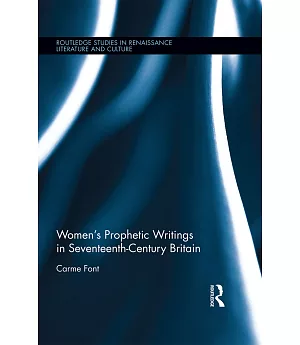

This volume examines women’s prophetic writing as the literary and historical outcome of a discourse of social transformation that conflates religious consciousness, political democratization, and gender identity. Drawing on a substantial corpus that integrates insightful readings of both household names and lesser-known authors, it identifies the key aspects that define prophetic writing by women in the seventeenth century and interprets each case study as being representative of a form of textual activism that blurs the boundaries between private and public. Contextualizing seventeenth-century prophecy in relation to its religious antecedents and its ramifications towards the eighteenth century, the book broadens discussions about how historicized readings, print culture, and gender concerns enhance our literary understanding of prophetic texts within the canon of early modern women’s writing. Seventeenth-century women prophets were imbued with a spiritual energy that forced them to articulate a message of their own. By virtue of discovering the power of language and communication, and by defending their word against the aggression of authorities, women gained a better sense of themselves as individuals with their own views. Since prophecy cannot be properly studied in isolation as a literary genre or as a historical phenomenon only, this book conflates religion, politics, and gender in the historical and literary appreciation of the prophetic text in the Renaissance. As such it will be of interest to scholars and students working in early modern literature and culture, social history, religious writing, and gender.